


The Theory of China Harmonious Innovation
By Prof Richard Li-Hua
Preface and Context
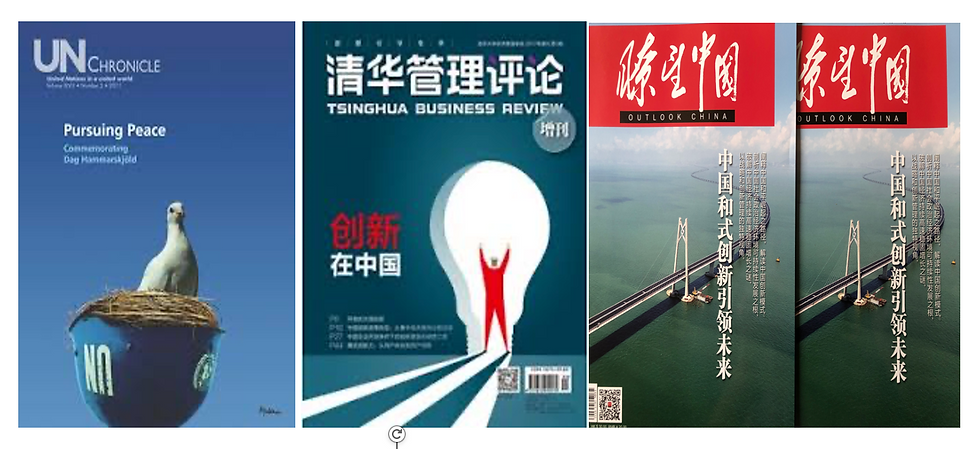

In March 2009, I had the privilege of delivering a keynote address titled "West Meets East: Integration of Western Management and Eastern Philosophy" at the CUALA Conference held at the University of Cambridge, where I was a Visiting Scholar at the Judge Business School and lived in Wolfson College. Since that time, I have published over 100 papers and given numerous speeches and published 6 books on this topic and themes of technology transfer, science and technology innovation and technology strategy, all with a global perspective.
In June 2016, I published my first academic paper on "The Theory of China Harmonious Innovation" in Tsinghua Business Review and subsequently I delivered my keynote speech entitled "China Harmonious Innovation Leads to the Future" at the 2016 CAMOT Conference, Cambridge University. Since then, I have published over 50 papers in both English and Chinese journals, including the United Nations Chronicle, Outlook China, Tsinghua Management Review, and Chinese Enterprise Management. These publications provide a comprehensive and in-depth exploration of the theory. In November 2017, I published the book China Harmonious Innovation Leads the Future which was previously translated as [China Embracing Innovation Leading to the Future] with China Enterprise Management Publishing House, offering a thorough and profound interpretation of the theory. Additionally, I have given over 30 speeches on the theme of "China Harmonious Innovation Theory" around the world, including at Tsinghua University, Beijing University, University of Cambridge, University of Oxford and the United Nations Headquarters in New York. This theory has generated enthusiastic discussions and high attention globally.

My second book, titled The Innovative Gene of Chinese Civilization: Harmonious Innovation Decodes the Innovative Rise of the Chinese Economy, will be published in Chinese in 2026. This work delves into the unique innovative spirit that has driven China's economic growth. Additionally, I have two more books in the pipeline. The Myth of China's Rise: Theory of China Harmonious Innovation and World Peace and Global Leadership: Confucius, Global Innovation and Resiliencewill be published in English in 2027 and 2028, respectively. These books explore the theoretical underpinnings of China's rise and its contributions to global peace and innovation. I am excited to share these insights with a broader audience in the coming years.
Over the past 10 years, I have received high praise, encouragement, and a variety of questions and comments on this topic from experts and scholars worldwide. This feedback has not only enriched my research perspective but has also further convinced me of the value and significance of the "China Harmonious Innovation Theory" for global peace and world development. Given the close connection between this theory and the promotion of world peace, I am eager to visit the University for Peace and collaborate with your esteemed institution to develop innovative, attractive, and targeted programs or projects. I also hope to join hands with your university and the United Nations to advance the cause of world peace. I believe that through our joint efforts, this theory will play an even greater role in promoting global peace and development and in fulfilling the mission of the United Nations.
From the Rise of China's Economic Innovation to the Theory of China's Economic Innovation: Theoretical Innovation and Practical Summary
The rise of China's economic innovation serves as a classic case and important foundation for constructing the theory of China's economic innovation. China's innovative practices cover multiple fields, including technological innovation, institutional innovation, social innovation, and cultural innovation. In terms of technological innovation, China has achieved remarkable accomplishments in high-speed rail, 5G communication, e-commerce, and other fields. Regarding institutional innovation, China's socialist market economy system is continuously improving, providing institutional safeguards for economic development. In the realm of cultural innovation, China emphasizes the philosophical concept of "harmony in diversity," which has propelled harmonious social development. In terms of philosophical innovation, China stresses the transition from "establishing perpetual peace for future generations" to "resolving enmity through reconciliation," which has facilitated China's Peaceful Rise.
The construction of the theory of China's economic innovation requires the distillation of universally significant theoretical viewpoints from these rich innovative practices. These theoretical viewpoints should not only explain China's development experience but also provide valuable references for other countries. By constructing the theory of China's economic innovation, China can more systematically explain its innovation and development models to the world, enhancing the international community's understanding and recognition of China's development.
China Harmonious Innovation Theory is proposed based on the great innovative practice case studies of Reform and Opening up. It is an endogenous social innovation, an innovation theory that has emerged spontaneously on Chinese soil. It is a strategic model that combines strength and flexibility, seeks common ground among the wise, and aims for joint construction, shared benefits, and mutual wins, falling within the category of intrinsic social innovation. Rooted in China's "harmony" culture, the Confucian doctrine of "harmony as the most valuable," and the essence of Chinese classical philosophy, which embraces contradictions, it provides a high-level strategic and innovation management summary of China's Reform and Opening up practices. It interprets China's innovation model, deciphers the mystery of China's 40 years of sustained, rapid, and stable economic development, analyzes the roots of China's sustainable social, political, economic, and environmental development, and elucidates the path of China's peaceful rise. While Western innovation theories focus on explaining economic phenomena, the theory of China Harmonious Innovation not only explains China's rapid economic development but also the path of its Peaceful Rise. China Harmonious Innovation integrates Chinese traditional culture with modern management thought in theory. Undoubtedly, the practice of China's Peaceful Rise and the theory of China Harmonious Innovation will subvert and rewrite the theories of the rise of great powers.
Significantly, the principles embedded within China Harmonious Innovation—particularly the emphasis on "embracing contradictions," "keeping pace with the times," and "maintaining harmony and inclusiveness"—offer a development paradigm particularly suited to the Global South. Unlike Western models that often prescribe uniform structural adjustments, China Harmonious Innovation respects diverse national contexts and supports sustainable development pathways that honor local cultural traditions while embracing technological advancement. The theory demonstrates that developing nations can achieve economic modernization without sacrificing social cohesion or environmental sustainability, providing the Global South with an alternative framework that balances growth with equity, and innovation with cultural continuity.
Innovative Practice: The Model Architecture and Path Selection of China Harmonious Innovation
China Harmonious Innovation is an all-encompassing, multi-level innovation system that not only demonstrates unique value in the superstructure and ideological fields but also shows distinctive significance in the realms of technological and innovation management. This innovation system comprises two core levels: innovation at the level of concepts and philosophy, and innovation at the level of technology and management. These two levels complement and reinforce each other, together forming the solid foundation of China Harmonious Innovation and making it a vital force in driving national progress.
At the conceptual and philosophical level, the core philosophy of China Harmonious Innovation emphasizes four key pillars: "embracing contradictions," "keeping pace with the times," "seeking common ground while reserving differences," and "maintaining harmony and inclusiveness." These principles are not only guiding principles for top-level design but also the keys to breaking free from traditional thinking and unleashing creativity. By "embracing contradictions," Chinese society is able to adopt a dialectical perspective to view issues, thereby finding sustainable development paths in a complex and changing social environment. This political wisdom and social development strategy enable China to maintain a stable development trend when facing various challenges and to promote continuous social and political progress. "Keeping pace with the times" is the spiritual core of China's Peaceful Rise. It reflects China's keen insight into and proactive adaptation to changes in the era during the process of governance. This principle not only drives the rapid development of China's economy but also plays an important role in environmental protection and sustainable development. By continuously adjusting and optimizing policies, China achieves economic prosperity while also focusing on the protection of the ecological environment, leaving valuable natural resources for future generations. In the field of diplomacy, "seeking common ground while reserving differences" is the cornerstone of China's foreign policy. This principle enables China to establish good and effective diplomatic relations with most countries around the world, promote multilateral cooperation, and contribute to global peace and stability. By respecting the differences of various countries and seeking common interests, China has won widespread respect and support on the international stage, creating a favorable external environment for its peaceful rise. "Maintaining harmony and inclusiveness" promotes the building of a harmonious society domestically and advocates the establishment of inclusive and win-win international relations internationally. This principle not only promotes domestic social stability and prosperity but also provides new ideas and solutions for global governance. By emphasizing harmony and inclusiveness, China plays a constructive role in international affairs and actively promotes the building of a community with a shared future for mankind.
At the technological and management level, China Harmonious Innovation achieves sustainable development of the economy and ecology by balancing "endogenous innovation" and "imitative innovation." Endogenous innovation is the core driving force of China's technological progress. It has driven breakthroughs and innovations in China's high-tech fields, enabling China to secure a place in global technological capacity building. At the same time, China also focuses on imitative innovation, learning from and absorbing advanced international technologies and management experience to rapidly enhance its technological level and management capabilities. This balanced strategy not only promotes rapid economic growth but also provides a scientific basis for environmental protection and resource utilization, laying a solid foundation for sustainable development.
Such innovation at the two levels complements each other. Innovation at the conceptual and philosophical level provides ideological guidance and spiritual motivation for innovation at the technological and management level, while innovation at the technological and management level provides a practical foundation and material guarantee for innovation at the conceptual and philosophical level. This mutually reinforcing relationship makes China Harmonious Innovation an organic whole and an important force in driving comprehensive social progress in China.
Through the four core pillars of "embracing contradictions," "keeping pace with the times," "seeking common ground while reserving differences," and "maintaining harmony and inclusiveness," China Harmonious Innovation leads the comprehensive and sustainable development of China's society, politics, economy, and diplomacy. At the same time, through innovative practices at the technological and management levels, China achieves economic prosperity while also focusing on environmental protection and social harmony. This all-encompassing innovation system not only provides strong momentum and an engine for China's development but also offers valuable experience and references for global sustainable development, particularly for emerging economies in the Global South seeking to navigate the complexities of modernization while preserving their cultural identities and ecological resources.
Innovation for Peace: Hope for World Peace in the Twenty-First Century
British historian Arnold Joseph Toynbee had unique insights into Chinese civilization. With his profound insight, Toynbee pointed out that Chinese civilization, as one of the very few in the world that has remained ever-renewing and stable over time, possesses astonishing adaptability, innovation, and transformative power. Throughout the course of history, Chinese civilization has always been able to rejuvenate itself in the face of challenges, becoming a brilliant beacon for humanity's pursuit of world peace and sustainable development. Toynbee highly praised the political philosophy and cultural traditions of Chinese civilization and even prophesied that the integration of Chinese and Western cultures would together weave the most beautiful chapter of human culture. He firmly believed that the twenty-first century would be the century of China.
In the long river of history, the rise of great powers has often been accompanied by the shadow of war and plunder, a significant feature of world history in the 18th, 19th, and 20th centuries. Those great powers that rose achieved their strength and prosperity through military expansion, resource plundering, and territorial disputes. However, this mode of rise not only brought profound disasters to the countries and nations that were plundered but also disrupted world peace and stability, making war and conflict the norm of that era.
Nevertheless, the wheels of history roll forward. In 1978, with its profound strategic vision and extraordinary political wisdom, China initiated the process of Reform and Opening up. This great decision not only enabled China to achieve a historic leap from poverty and backwardness to prosperity and strength but also ushered the world into the new era of the 21st century ahead of schedule. China's Reform and Opening up brought hope and light to the world, representing a unique path of China Harmonious Innovation, peaceful development, and peaceful rise. China has adhered to the path of peaceful development, continuously deepened reforms, expanded openness through endogenous social innovation, achieved rapid economic growth, and made comprehensive progress in society and politics, realizing sustainable development of the economy and the environment. At the same time, China has actively advocated multilateralism, participated in global governance, and promoted the building of a community with a shared future for mankind, making positive contributions to world peace and development. This mode of Peaceful Rise not only avoids the Thucydides Trap but also provides valuable lessons and inspiration for other countries in the world, especially for developing nations in the Global South seeking alternatives to conflict-driven development models. The classic case of China's Peaceful Rise undoubtedly provides strong evidence for world peace and development. It proves that a great power can completely rise peacefully through endogenous social innovation. This successful case not only demonstrates China's wisdom and responsibility but also fills people with confidence for the future of the peaceful world.
We can say that world peace in the 21st century is hopeful, and the China Harmonious Innovation Theory, which is sublimated from the practice of China's Peaceful Rise, is the best response to this proposition. China's successful experience tells us that peace and development are complementary, and innovation and rise are mutually enhancing. Only in this way can we achieve long-term stability and prosperity for the countries and the world. Let us join hands and work together to promote the cause of world peace and development and create a better future for humanity.
Closing Remarks
In the long history of ancient Greece, peace was endowed with the supreme value. It was not only the cornerstone of social harmony and order but also a core issue deeply explored in Homer's epics. With his unique writing style, Homer depicted the ancient Greeks' profound reflections on war and peace. He emphasized the paramount importance of peace and harmony. He firmly believed that through rational dialogue and the bridge of cooperation, humanity could transcend differences, avoid unnecessary conflicts and violence, and jointly create a tranquil and peaceful society.
From Toynbee's wise prophecy to the grand vision of China Harmonious Innovation leading the future, this process is not accidental but an inevitable manifestation of the laws of human social development. China Harmonious Innovation, based on its unique concept of Innovation-for-Peace, promotes the process of world peace. Looking back through the long river of history, innovation has always been the inexhaustible driving force for the rise of nations and the rejuvenation of peoples. The prosperity of a country is often closely linked to the uplift of its national spirit and the revival of its cultural traditions. In today's rapidly changing era, the awareness of innovation for peace is even more the core competitiveness of national development.
Therefore, every country and nation should delve deeply into its own historical context, clarify its positioning and future direction. In the era of globalization, peaceful innovation, peaceful development, and peaceful rise have become an irreversible trend of the times. We look forward with anticipation that Homer's epics, Confucian and Zhang Zai's wisdom and innovative concepts can join hands to jointly lead the world in the twenty-first century towards peace, harmony, and prosperity, and together build a community with a shared future for mankind.
Furthermore, the future development of China Harmonious Innovation Theory will be enriched by emerging conceptual frameworks including the Mather Chain Protocol (MCP) and the Harmonious Progressive Innovation Model (HPIM). These innovative mechanisms represent the next evolution of harmonious innovation methodology, offering structured approaches to collaboration and sustainable technological progression that will further enhance the theory's applicability to global development challenges.


Comments